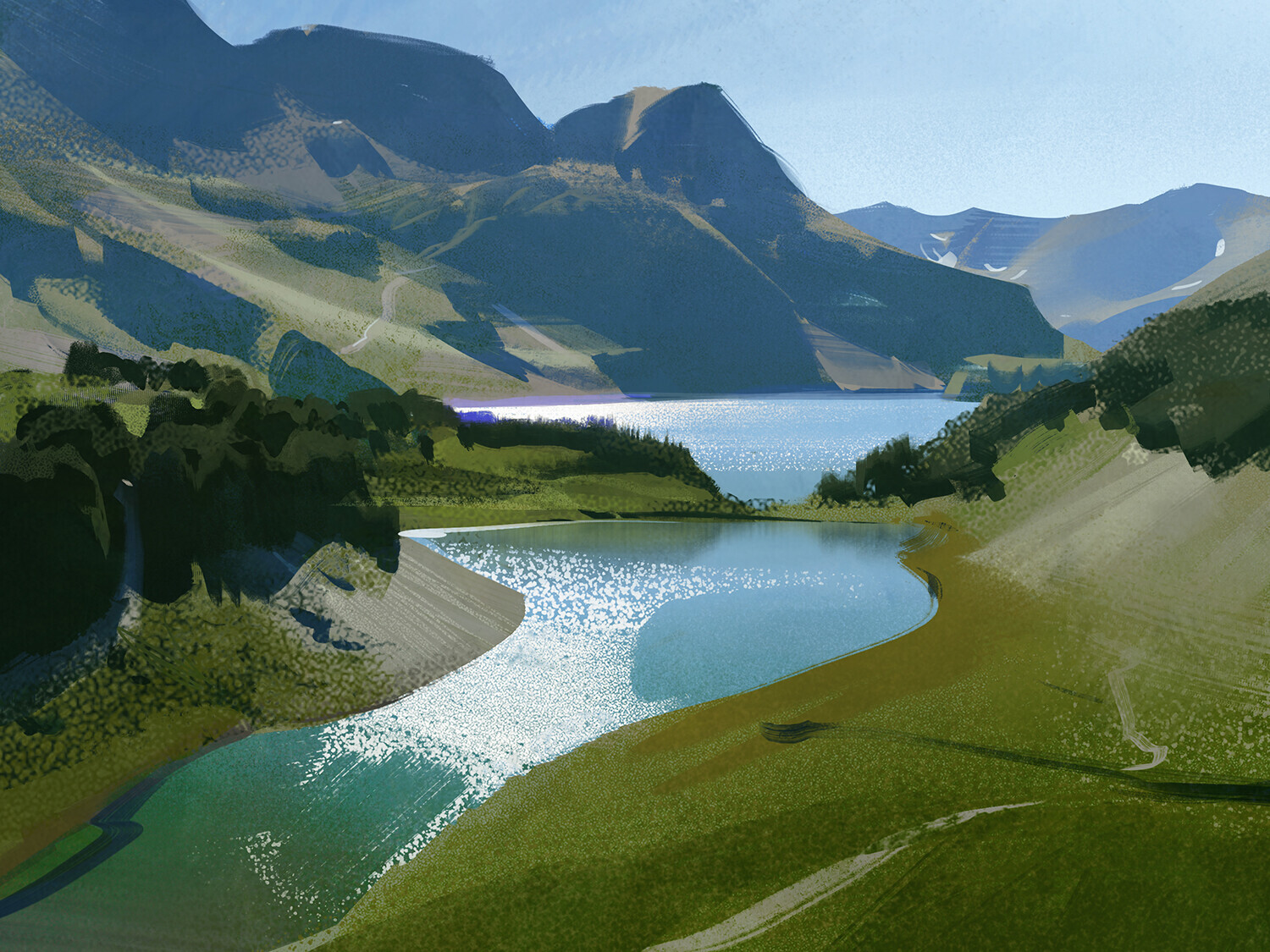
Rhone
Rhone is an old kingdom of lush timber and black soil.
It has long acted as a gateway between the countries that surround it:
The drier and colder northwestern countries of Kyrosos & Eerde, the mountainous coastal southeastern countries of Saalzych & Praudia, the warmer countries of Spiacia & Apierto to the south across the Long Sea, and the dense northern forests of the elves.
The major cities of Rhone are often populated by (mostly) invited foreign merchants and craftsmen, making a cultural divide between Rhone's traditional rural life and the walled centers of trade.
The kingdom had been through a period of intense and bloody fracturing until King Andrick (current King Casimir's grandfather) unified the rival duchies. This transformed a struggling land into a multi-ethnic commonwealth, shifting its status from mere outpost to the dominant power of the northern kingdoms.
The wide country is the home of many beasts, such as the wyverns along the coast, goblins of the northwest, hobgoblins in the east, and the occasional ogre or griffin.
Rhonans primarily speak the language Rhonic. Depending on the region, many of them would be familiar with the languages of the neighboring countries. A scant few would know dwarvish or elvish.
Rhonic names:
Masculine:
Abelard, Ambroz, Antonin, Bastien, Bjorg, Calev, Djenge, Elihal, Eskel, Folan, Gaetan, Havart, Ivar, Mikah, Phillipe, Rohsyn, Solbrycht, Ves, Volund
Feminine:
Agneta, Amrynn, Anisse, Astrid, Carthia, Corinne, Emilia, Genowefa, Irina, Izydora, Klara, Marja, Meredin, Mikula, Nissa, Priscilla, Roza, Svana, Teodora
Biennia, city
Origin:
Near-coastal trading post turned religious hub due to the divine giant, called Upagid, who fell into the city roughly 250 years ago.
The Fallen Giant, Upagid
250 years ago, a giant walked inland from the sea until it stood in the middle of Biennia and collapsed.
Now the giant's body is slowly mined for the substance of his body, pith.
Pith in its raw state is extremely hard, and it is difficult to mine and process.
Once processed, it's used for many things: a compact energy source, a restorative substance in alchemy and potion-making, a sacred paint in religious rituals that helps users touch the divine, and in various forms of snake oil.
Outside the city:
Agriculture farming, logging camps, and barrows surround the city.
Fortification:
Heavily Fortified.
The Sones (a religious order who believe Upagid is the son of Aotha, goddess of the dawn, learning, mists, and softness) maintain and patrol a raised stone wall that encircles Biennia.
Undercity:
There is a network of sewers as well as extensive mining tunnels that go throughout most of the city, especially around the fallen giant.
Population:
86,000 metro
27,000 surrounding
Fairly populated. Only a couple of smaller districts are sparse, and a couple of districts are very dense.
Biennia is 99% human with the occasional elf or dwarf.
Visitors:
Being a trade city with a major religious icon, many number of people go through Biennia regularly.
Nighttime activity is fairly active besides in a few districts.
Control of the city:
Control is split between 3 major factions and 1 minor faction.
The Magistrates - Biennia's Republic
Leader: The Magistrates are Biennia’s City Council and is made up of:
- Arenthiel, elf
- Leonon Voynik, veteran Elite Paladin of the King's First Legion
- Tomanz Orkan, former merchant
The City Council works with Duke Lensar Kiezka (the King’s brother) to command the majority of the King's First Legion.
The Workhands - Trade Guild
Leader: Helsa Fvorsen, dwarf
Helsa is the roadwarden and commissioner who hears and is a voice for the major mercantile businesses in Biennia and the surrounding areas.
The Workhands balance the needs of the pith miners, porters, loggers, farmers, laborers, and artisans.
Vointa Pospul - Criminal alliance
Leader: Evange Andreu, ex-legion captain
Enough incidents have occurred that most folk don’t have trouble believing that Vointa Pospul controls a sizable portion of the city. They operate quietly but ambitiously, sometimes carrying out high-profile jobs.
They have ties and plants in many places in Biennia.
The Sones
Leader: Iolanthe Pereos, Kyrosan
A religious order who believe the fallen giant Upagid is the son of Aotha, goddess of the dawn, learning, mists, and softness.
The Sones are unsanctioned as leaders and only have any say in how the city is run because of their popularity and their maintenance & patrol of the city wall.
General Condition:
Decent— some areas are dilapidated and in need of care, but some areas are fairly impressive and wealthy.
The area around Upagid is in a constant state of construction & repair.
Stewardship:
Adequate but not perfect.
The Magistrates pride themselves on in preserving the culture and reinforcing the community’s access to knowledge and opportunity, but politics often get in the way of fixing issues.
Many say the Magistrates are too focused on economics and not enough on people.
Recent political history
- Anteac the Paragon demands fealty from King Casimir Kiezka of Rhone.
- Anteac takes Falkow (capital of Rhone) with minimal violence by a two-front attack from Saalzych.
- King Casimir confirms Anteac as the Prime Sovereign of the northern kingdoms.
- Praudia, Kyrosos, and Eerde form the Pact of Strength as a show of force against Anteac's attempted annexation, an alliance of the smaller countries in the northern kingdoms.
- The Duke and The Magistrates fortify the King's First Legion around Biennia.
Districts
This is a later problem for me to solve!